
TL;DR: Being active at work isn't necessarily the same as intentional exercise. New research suggests leisure-time activity may offer health benefits that physically demanding work doesn't.
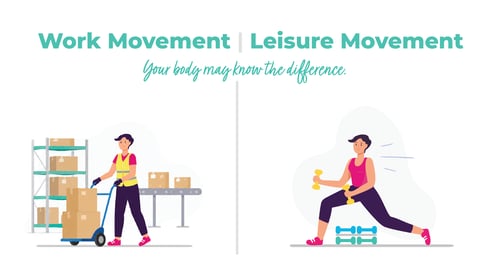 If you spend eight hours walking, lifting, carrying or standing at work, hitting the gym afterward might sound a little ridiculous.
You moved all day. Surely that counts as exercise, right?
It counts as physical activity, but new research suggests our bodies may respond differently to movement we do at work and movement we choose to do in our free time.
In fact, a large new review found a surprising difference between leisure-time exercise and physical activity on the job, especially when researchers looked at dementia risk.
So, if you already have a physically demanding job, do you still need to exercise?
What Is the Physical Activity Paradox?
We usually talk about physical activity as if all movement goes into the same bucket.
Walk 10,000 steps at work? Great.
Walk 10,000 steps through your neighborhood? Also great.
Spend the day lifting boxes? That has to count for something.
Of course, movement is movement. But the circumstances surrounding that movement can be very different.
Leisure-time physical activity might mean taking a brisk walk with a friend, riding a bike, swimming, playing pickleball, lifting weights or going to a yoga class. You usually choose the activity, how hard you want to work and when you're ready to stop.
Physical activity at work often looks different.
A warehouse employee may repeatedly lift and carry objects for hours. A nurse may spend most of a shift walking and standing. A construction worker might lift, bend and work in uncomfortable positions throughout the day.
The person may have little control over the pace, intensity or duration of that activity.
That's the basic idea behind thephysical activity paradox. The health effects of movement may depend partly on where, why and how that movement happens.
What Did the Research Find?
If your job has you on your feet all day, lifting, carrying, or moving nonstop, you've probably told yourself you don't need to hit the gym. You're already active for eight (or more) hours a day. That should count, right?
New research says it's a lot more complicated than that.
A massive study looked at 74 studies involving more than 4.2 million people across 30 countries, and the findings might surprise you. People who were physically active during their leisure time had a 24% lower risk of developing dementia compared to those who were least active. That part tracks with what we already know about exercise and brain health.
Here's where it gets interesting: being physically active at work was associated with a 20% higher risk of dementia.
But there is one big thing to keep in mind.
This was an observational review, which means researchers looked at existing data and found a pattern. It doesn't prove cause and effect. Observational studies can point us toward important questions, but they can't tell us definitively why something is happening, only that it is.
Researchers believe the connection may have less to do with physical activity itself and more to do with some of the conditions that can come with physically demanding jobs.
Manual occupations may involve higher levels of stress, less control over working conditions, hazardous workplace exposures, and greater exposure to air and noise pollution. Some of these factors have independently been linked to dementia risk. Workers in physically demanding jobs may also have less time or energy for recreational exercise outside of work.
That means the increased risk seen in the study could reflect a much bigger picture than how much someone moves during the workday.
Why Might Exercise Feel Different to Your Body?
Think about a 30-minute bike ride compared with an eight-hour shift spent repeatedly lifting, bending and standing.
Both involve physical activity, but they place very different demands on the body.
Researchers believe several factors could help explain the difference.
- Recovery time: A workout has a beginning and an end. Afterward, your body gets time to recover. Physically demanding jobs can involve activity for hours with limited opportunities for rest.
- Control: During a workout, you can slow down, change exercises or stop. Employees don't always have that same control over the physical demands of their jobs.
- Type of movement: Exercise often involves changing movements and intensities. Some jobs require repetitive movements or long periods of standing, lifting or carrying.
- Stress: A walk after dinner might help you unwind. Walking around a busy workplace while trying to meet deadlines can be a completely different experience.
- Other workplace exposures: Shift schedules, noise, air pollution and psychosocial stress can also affect health and may help explain some of the associations researchers see in physically demanding occupations.
Previous research on occupational activity has suggested that differences in heart rate, blood pressure, inflammation, recovery and control over work could help explain why occupational and leisure-time activity don't always produce the same health outcomes. Researchers are still working to understand those mechanisms.
Does Being Active at Work Count as Exercise?
Yes, but it may not completely replace intentional exercise.
That's an important distinction.
Someone who spends the day doing physical work isn't sedentary, and that activity certainly contributes to their total daily movement. They also don't necessarily need to leave work and force themselves through an exhausting workout.
Instead, the research makes a good case for thinking about what kind of movement might complement the activity they're already getting.
If your job involves standing all day, that might mean swimming or cycling. If you repeatedly lift at work, you might enjoy walking outside. If work is physically exhausting, a gentle yoga class or mobility session might feel better than a high-intensity workout.
And sometimes, the best choice is simply rest.
The goal doesn't have to be piling more physical stress onto an already tired body.
Enjoyment May Be More Important Than We Give It Credit For
There's another difference between work and leisure activity that's easy to overlook.
Choice.
You don't choose to carry something across a warehouse because it's your favorite way to spend a Tuesday afternoon.
You might choose to take your dog for a walk, play tennis with a friend or go dancing.
That matters because leisure-time activity can bring other benefits along with movement. It can be social. It can get you outside. It can give your brain a break from work. And when you actually enjoy an activity, you're more likely to keep doing it.
Exercise doesn't need to look like someone else's perfect workout routine.
The best exercise is often the one you enjoy enough to keep coming back to. Walk. Swim. Garden. Dance. Hike. Lift weights. Ride your bike. Join a recreational sports league. Find something that feels good in your life.
What This Means for Workplace Wellness Programs
This research also gives employers something to think about.
Many workplace wellness programs focus heavily on getting employees to move more. Step challenges, walking meetings and fitness challenges can be great options for employees who spend most of their workday sitting.
But what about the employee who already logged 15,000 steps before lunch?
Their wellness needs may look very different.
For employees in physically demanding roles, consider wellness activities that support the body instead of simply asking it to do more.
- Offer mobility and stretching sessions. Help employees address stiffness and repetitive movement patterns.
- Encourage real breaks. Recovery during a physically demanding shift matters.
- Include lower-impact wellness options. Yoga, walking, swimming and mobility work give employees alternatives to high-intensity fitness challenges.
- Make challenges flexible. Don't build every wellness campaign around step counts. Give employees different ways to participate.
- Talk about sleep and recovery. Physical wellness includes giving the body time to recover from demanding work.
- Give employees choices. A wellness program works better when people can choose activities that fit their jobs, abilities and interests.
This is also why workplace wellness shouldn't look exactly the same for every employee.
Someone sitting at a computer for eight hours and someone loading trucks for eight hours may work for the same organization, but their bodies have very different workdays.
Movement Still Matters
None of this changes the bigger message about physical activity.
Regular physical activity remains one of the habits associated with better long-term health, including brain health. The new research simply adds another layer to the conversation.
How we move may matter along with how much we move.
For employees with desk jobs, finding more opportunities to get up and move can be valuable. For employees with physically demanding jobs, the better wellness goal may be finding enjoyable movement outside of work while also making room for recovery.
And for employers, it is a good reminder that wellness doesn't have to mean asking everyone to hit the same step goal.
Sometimes the healthiest thing you can do is meet employees where they already are.