
TL;DR: Short on time but running on empty? These simple 10-minute resets help employees recharge between meetings, boost focus, and reduce stress without stepping away from their workday.
Back-to-back meetings. Deadlines piling up. Slack going off again before you’ve even finished the last message. It’s a lot. Most days just feel packed. There’s barely a gap to think, let alone step away and reset.
What does help is surprisingly simple. You don’t need a full break or a perfect window in your calendar. Just a few intentional minutes can change how you feel and how you think.
We’re talking 10 minutes. Sometimes less.
That’s enough to clear your head, take the edge off, and come back with a little more focus. Do it a couple times a day and it starts to add up in a real way.
So whether you’re trying to support your team or just get through your own schedule without feeling drained by mid-afternoon, this is for you. Below, we’ve rounded up the most effective 10-minute mental reset techniques that actually fit into a busy workday.
Why Mental Breaks Are Non-Negotiable
Before we dive into the techniques, let’s address the elephant in the room: many employees feel guilty about stepping away from their desks. There’s still a pervasive belief in many workplace cultures that “busy” equals “productive.”
But neuroscience tells a different story. The brain is not designed for sustained, uninterrupted focus. Cognitive performance degrades after roughly 90 minutes of concentrated effort, and for many workers, that decline starts much sooner. Regular mental breaks:
- Restore attention and focus
- Lower cortisol (the stress hormone)
- Improve decision-making and creativity
- Reduce the risk of chronic burnout
- Boost overall job satisfaction
Simply put: If you want people to stay focused and do good work, they need breaks.
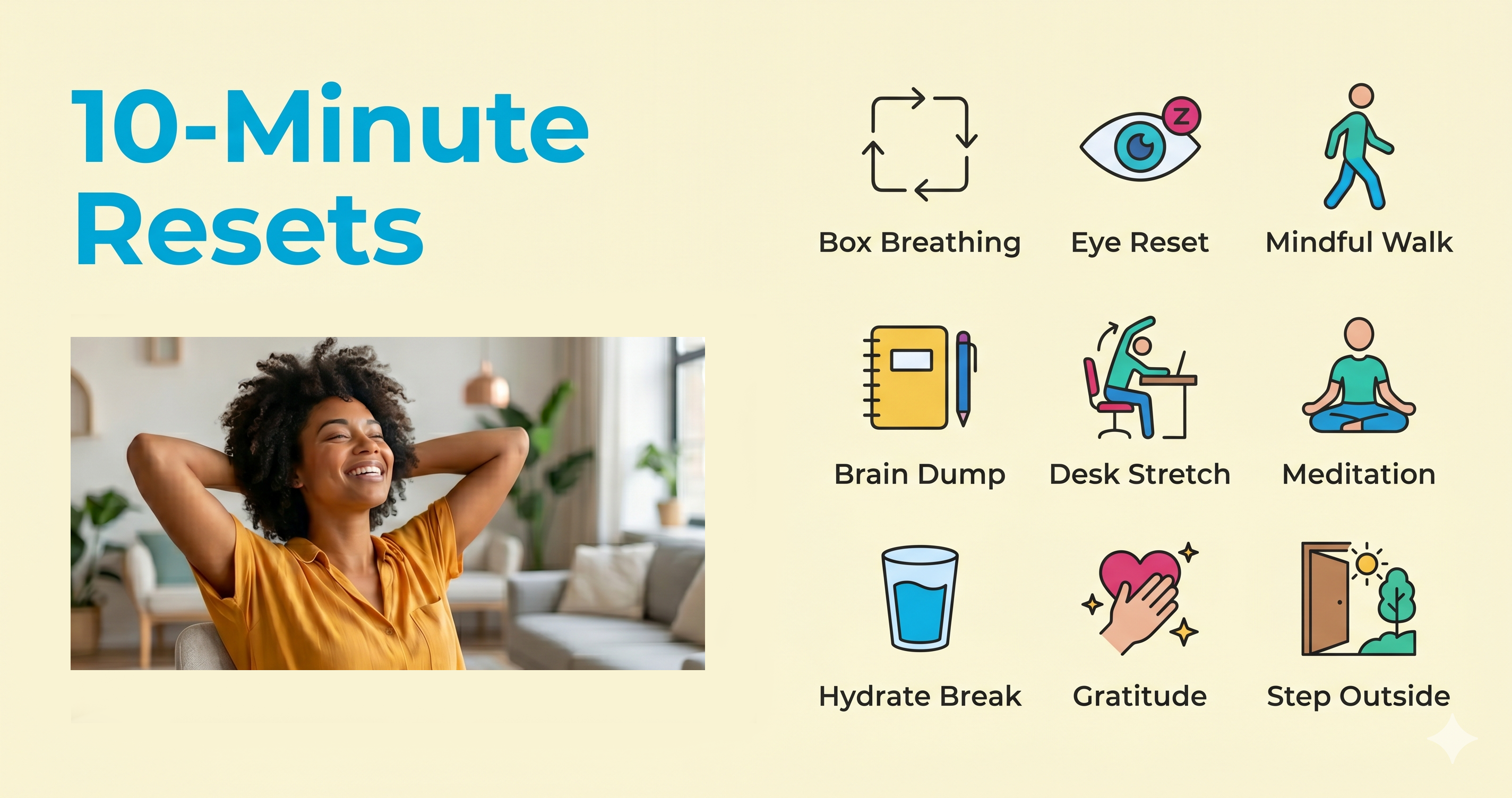
10 Mental Reset Techniques That Take 10 Minutes or Less
1. Box Breathing
Box breathing is a simple breathwork technique used by military personnel, athletes, and therapists alike to rapidly calm the nervous system. It’s discreet enough to do right at your desk.
How to do it:
- Inhale slowly for 4 counts.
- Hold your breath for 4 counts.
- Exhale slowly for 4 counts.
- Hold for 4 counts. Repeat 4–6 times.
This technique activates the parasympathetic nervous system, lowering heart rate and reducing anxiety quickly. It’s especially useful right before a high-stakes meeting or after a stressful conversation.
2. The 20-20-20 Eye Reset
Screen fatigue is one of the most underestimated sources of afternoon brain fog. The American Optometric Association recommends the 20-20-20 rule to reduce digital eye strain:
Every 20 minutes, look at something 20 feet away for at least 20 seconds.
This gives your eye muscles a chance to relax and can reduce headaches, blurred vision, and that mid-afternoon mental heaviness that often gets mistaken for boredom or fatigue.
3. A Mindful Walk
You don’t need to hit the gym. Even a short walk around the office building, down the hallway, or around the block can do wonders. The key word is mindful. Leave your phone behind (or at least put it in your pocket) and pay attention to what’s around you.
Research from Stanford University found that walking increased creativity in 81% of participants, with overall creative output rising by about 60%. That spark of creativity you’ve been chasing at your desk might be waiting for you around the corner.
HR Tip: Encourage walking 1:1 meetings to normalize movement during the workday.
4. The Brain Dump
Mental clutter is exhausting. When your brain is juggling a to-do list, half-finished conversations, and tomorrow’s concerns all at once, it’s nearly impossible to focus on the task in front of you.
The brain dump is simple: grab a notepad (or open a blank document) and spend five minutes writing down everything on your mind. No filtering, no organizing — just get it out. This offloads cognitive burden, creates a sense of control, and clears the mental workspace for whatever comes next.
5. Stretch It Out
Sitting for extended periods tightens hip flexors, strains the lower back, and reduces blood flow to the brain. A quick desk stretch routine doesn’t require a mat, workout clothes, or any special equipment.
Try these simple office stretches:
- Neck rolls (30 seconds each side)
- Shoulder shrugs and chest opener
- Seated spinal twist
- Standing hip flexor stretch against the wall
- Wrist and forearm stretch (great for heavy typers)
Movement releases endorphins, improves posture, and gives the mind a genuine break from screen-based focus.
6. Guided Meditation or Mindfulness App
Apps like Headspace, Calm, and Insight Timer offer guided meditations as short as three minutes. These are designed specifically for beginners and skeptics — no prior experience required.
Meditation has been clinically shown to reduce anxiety, improve emotional regulation, and increase gray matter density in brain regions linked to focus and self-awareness. Even a few minutes of guided breathing can quiet the mental noise enough to approach the rest of the day with greater clarity.
HR Tip: Many wellness programs offer subsidized app subscriptions as a low-cost, high-impact benefit. It’s worth exploring as a team resource.
7. Hydrate and Step Away From the Screen
It sounds almost too simple, but chronic mild dehydration is one of the most common causes of afternoon cognitive decline, fatigue, and headaches in office workers. Studies show that being just 1–2% dehydrated can impair short-term memory, concentration, and mood.
Make it a ritual: step away from your computer, walk to the kitchen, fill up a glass of water, and spend 2–3 minutes doing nothing except drinking it. The physical movement, the screen break, and the hydration hit combine into one of the most underrated resets of the day.
8. The Gratitude Pause
Gratitude isn’t just feel-good fluff, it’s a well-researched psychological intervention. Taking three minutes to write down 2–3 things you’re grateful for (even small things like a good cup of coffee or a productive morning) shifts the brain out of threat-mode and into a more positive, open state.
Research from Harvard Health shows that gratitude practices are consistently linked to better mood, greater happiness, and stronger overall well-being. Other studies show they can also reduce symptoms of anxiety and depression and increase life satisfaction. It’s a quick, private, zero-cost reset that employees can do right at their desks.
9. Step Outside for Natural Light
Natural light is a powerful biological regulator. It supports healthy circadian rhythms, boosts serotonin production, and can significantly elevate mood and energy. Yet many employees spend entire workdays under artificial fluorescent lighting without ever stepping outside.
Even a brief outdoor exposure — walking to the parking lot, sitting on a bench outside the building, or eating lunch in a courtyard — can reset energy levels and improve afternoon alertness better than another cup of coffee.
10. Listen to a Song
Music is one of the fastest ways to shift how you feel. Putting on headphones and listening to one song on purpose, not as background noise, gives your brain a break from work thinking and lets you step into a different emotional space.
Upbeat playlists can bring back energy and help you refocus. Calm, instrumental music has been shown to lower cortisol and ease stress. Songs tied to memories can give you a quick lift in mood. The key is being intentional. Pick the song, stay with it, and let it do its job.
How Employers Can Build a Culture of Mental Recovery
Knowing these techniques is one thing. Actually using them during a busy workday is another. As HR and wellness leaders, you have a powerful role in making mental resets feel normal, encouraged, and accessible. Here are a few ways to do that:
- Model it from leadership. When managers take visible breaks, it gives employees permission to do the same. Encourage people leaders to share their own reset routines.
- Block “buffer time” between meetings. A simple calendar policy of ending meetings five minutes early creates built-in reset windows for the whole team.
- Create a designated quiet space. A wellness room, meditation corner, or even a quiet lounge gives employees a physical cue that taking a break is both allowed and supported.
- Include it in wellness challenges. Add a “Take a 10-Minute Reset” challenge to your monthly wellness program. Track participation and celebrate it.
- Share resources proactively. Send a quick newsletter tip, hang up a poster with the 20-20-20 rule, or include box breathing in a team stand-up. The more familiar these tools become, the more likely employees are to use them.
Small Pauses. Big Impact.
The most sustainable high performers are not the ones who push nonstop. They are the ones who respect the rhythm between effort and recovery, and they treat their breaks with the same care as their work time.
Ten minutes will not fix every source of stress at work. But over a week, a month, or a year, those small resets start to build something meaningful. Less burnout. Better focus. Stronger morale. People who feel supported.
Invite your employees to choose one technique from this list and try it tomorrow. Then encourage them to share it with their team. A simple reset can spread quickly, and that is a good thing.