
TL;DR: Not every employee works best at the same time of day. Some people are sharp at sunrise. Others hit their stride later in the afternoon. Chronotypes help explain these natural energy patterns. When companies understand them, they can improve focus, productivity, communication, and overall life quality at work.
Picture this: it’s 9:00 AM on a Monday. The office is buzzing, and back-to-back meetings are locked in. For some, it’s energizing; for others, it’s a productivity nightmare.
The difference may come down to chronotypes — your body’s natural, biologically driven preference for when you sleep, wake, focus, and perform at your best throughout the day.
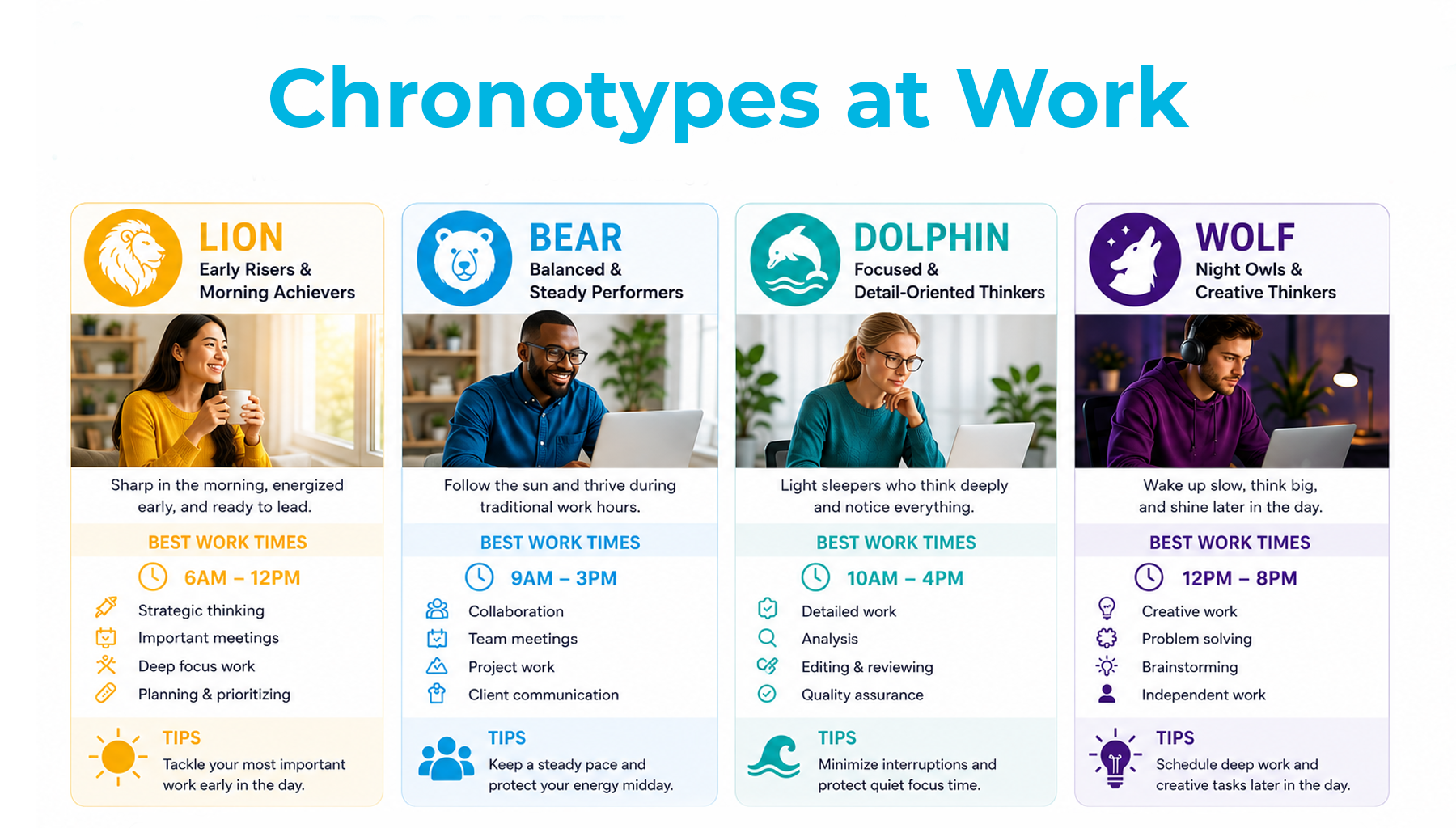
Most people generally fall into four chronotype categories: Lions, Bears, Dolphins, and Wolves. Some thrive early in the morning, while others hit their peak energy much later in the day.
It’s not a personality quirk or a lack of discipline. It’s science. And when employers ignore it, they often end up with disengaged teams, sluggish output, and employees grinding through their most important work at exactly the wrong time.
This article explores the four workplace chronotypes and how understanding them can help organizations better support productivity, focus, and employee wellbeing.
The Four Chronotypes: Which One Are You?
While everyone has unique energy patterns, most people tend to align most closely with one of four chronotypes: Lion, Bear, Dolphin, or Wolf. Understanding chronotypes can help explain why certain schedules, meeting times, and workloads feel energizing for some employees and draining for others.
The framework, popularized by sleep specialist Dr. Michael Breus, connects chronotypes to circadian rhythms — the body’s natural 24-hour cycle that influences sleep, focus, alertness, and energy levels.
Understanding these patterns can help employees work more effectively and help organizations design healthier, more productive work environments.
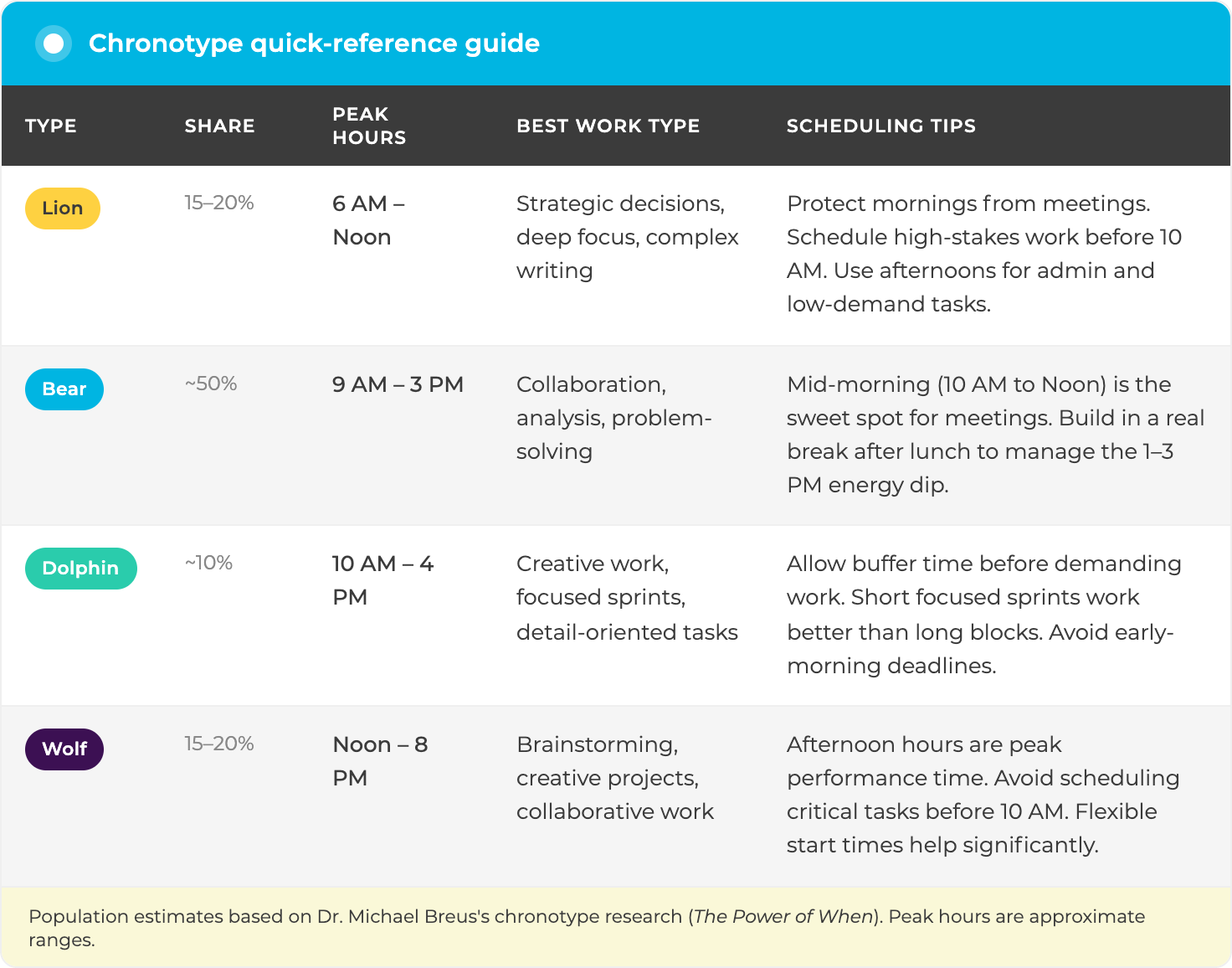
Here is a quick breakdown:
Why This Matters More Than You Think
This is not a soft wellness topic. Chronotype misalignment has measurable consequences.
Research published in the journal Current Biology found that "social jetlag," a term used to describe the mismatch between your internal clock and your required schedule, is associated with increased risk of obesity, cardiovascular disease, and depression. A separate study from Harvard Medical School found that circadian disruption can reduce cognitive performance at levels comparable to sleep deprivation.
For employers, the numbers are just as telling:
- The CDC reports that sleep insufficiency affects roughly 1 in 3 American adults, and workplaces are a major contributing factor.
- Employees with chronic sleep issues cost employers an estimated $1,967 more per year in productivity losses compared to well-rested employees, according to research published in the Journal of Occupational and Environmental Medicine.
- Gallup research consistently links employee wellbeing to engagement, and disengaged employees cost U.S. organizations up to $550 billion annually in lost productivity.
When employees are forced to do deep, cognitively demanding work during their biological low points, they produce lower-quality output, make more errors, and burn through mental energy faster. That is not a time management problem. It is a biology problem.
What Each Chronotype Needs at Work
Understanding chronotypes is useful. Acting on that understanding is where the real impact happens.
Lions: Protect the Morning
Lions are sharpest between roughly 6:00 AM and noon. Complex problem-solving, strategic thinking, and high-stakes decision-making should happen early. Afternoons are better suited for collaborative meetings, administrative tasks, and lower-demand work.
What helps Lions thrive:
- Early start times and protected morning blocks with no meetings
- Scheduling performance reviews, presentations, and deadline-sensitive deliverables in the morning
- Recognizing that their energy naturally winds down by mid-afternoon (this is not laziness)
Bears: Mid-Morning Is the Sweet Spot
Bears follow the solar cycle most closely. They warm up between 9:00 and 10:00 AM, peak around mid-morning to early afternoon, and hit a noticeable slump between 1:00 and 3:00 PM. After that, a moderate second wind often kicks in.
What helps Bears thrive:
- Meetings and collaboration scheduled for late morning (10:00 AM to noon works well)
- A real break after lunch, even 10 to 15 minutes, to support the natural early-afternoon dip
- Deep focus work in the morning before the day gets fragmented by meetings
Dolphins: Routine and Late-Morning Windows
Dolphins tend to have irregular, light sleep patterns and often feel mentally foggy in the early morning. Their cognitive performance improves late morning and can extend into early evening.
What helps Dolphins thrive:
- Flexible start times or buffer time in the early morning before demanding work begins
- Short, focused work sprints rather than long, uninterrupted blocks
- Routine and structure, because inconsistency tends to amplify anxiety and scattered focus for this group
Wolves: Afternoons and Flexibility Are Key
Wolves are at their biological low point during the traditional morning meeting block. Their alertness, creativity, and executive function genuinely improve in the afternoon and evening.
What helps Wolves thrive:
- Flexible or later start times where the role allows
- Creative work, brainstorming, and collaborative projects scheduled for afternoon hours
- Avoiding critical decision-making tasks in the early morning when their cognitive function is at its lowest
How Leaders Can Optimize the Workplace for Chronotypes
The conventional 9-to-5 schedule was not designed around human biology. It was designed around industrialization and standardized labor. Yet most workplaces still default to morning-heavy schedules, treating 9:00 AM as the universal starting line for meaningful work.
Here is the reality: for Bears (the most common chronotype), 9:00 AM is a warm-up period, not a peak performance window. For Wolves, it can feel like running a race while still half asleep. And for employees who are already stretched thin, forcing peak cognitive tasks into a biological low point is a recipe for burnout.
This does not mean every organization needs to overhaul its entire schedule. It does mean that small, thoughtful adjustments can make a real difference. These practical steps can create meaningful flexibility without creating scheduling chaos.
1. Introduce meeting-free blocks. Designate at least one two-hour block each day (or per week for smaller teams) where no meetings are scheduled. Employees can use that time based on when they focus best.
2. Shift the default for 1:1 meetings. Instead of defaulting to 9:00 or 10:00 AM for check-ins, let employees and managers co-schedule based on mutual availability. The best 1:1 is the one where both people are actually alert.
3. Encourage employees to identify their own chronotype. Share resources like Dr. Michael Breus's free chronotype quiz (available at thesleepdoctor.com) or include a short chronotype education piece in your next wellness newsletter. Awareness alone can help employees self-manage more effectively.
4. Build in a real midday break. A 20-minute midday reset is not a productivity killer. For Bears (your largest employee group), it directly combats the post-lunch dip and supports afternoon output. For everyone, it reduces afternoon fatigue.
5. Reconsider early-morning all-hands meetings. These tend to work well for Lions and early Bears, but they can undermine the performance of a meaningful portion of your team. If the goal is engagement and ideas, scheduling these for late morning often produces better participation.
6. Create flexibility where the role allows. Remote and hybrid work has already demonstrated that flexible hours do not tank productivity. For roles where schedule flexibility is possible, letting employees anchor their deep work to their peak hours is one of the most evidence-backed ways to improve output.
A Quick Note for Managers
If you manage people, your own chronotype is influencing your team more than you might realize. A Lion manager who schedules deep-dive strategy sessions at 7:30 AM may be unintentionally disadvantaging the Dolphins and Wolves on their team.
Building even a small amount of chronotype awareness into how you structure meetings, deadlines, and expectations can shift the environment for your team in meaningful ways. It signals that performance is about output and quality, not about performing alertness during arbitrary morning windows.
Quick Questions About Chronotypes
Can your chronotype change?
Yes, chronotypes can shift with age. Children are often early types, adolescents shift toward late types (Wolves), and older adults typically trend back toward being Lions.
How can employees figure out their chronotype?
One simple way is to track when you naturally feel most alert, focused, creative, and tired throughout the day. Patterns often become clear after a few weeks.
What is the best chronotype for a CEO?
While many CEOs are Lions (Early Birds), success is more closely linked to circadian alignment — working in sync with your specific type rather than forcing a specific one.
Does "exercise snacking" help with the afternoon slump?
Yes. For Bears and Dolphins, short bursts of movement (exercise snacking) during their biological low points can boost circulation and mental clarity without the need for caffeine.
Helping Employees Thrive Naturally
Chronotypes are not an excuse or a personality preference. They are a biological reality backed by decades of circadian rhythm research. When employees are asked to do their most demanding work during their body's natural low points, the results show up as errors, fatigue, disengagement, and over time, burnout.
For HR and wellness professionals, chronotype education is a low-cost, high-impact addition to any workplace wellbeing strategy. It does not require a budget overhaul. It requires awareness, a willingness to build in flexibility, and a recognition that a one-size-fits-all schedule is not actually working for everyone.
The most productive workplaces are not the ones that start earliest. They are the ones that start smartest.