
TL;DR: Employees don’t ignore wellness benefits because they don’t care — they don’t use them because they’re too hard to access. When someone is already stressed or low on energy, even a few extra steps are enough to stop them. If you want programs to work, make them simple, fast, and easy to use in the moment they’re needed.
You bought the shiny new wellness platform. You threw the virtual confetti in the company newsletter. You even sent that "Gentle Reminder" email with the login link (which we all know is HR-speak for please, for the love of everything, just click this).
And yet? The participation dashboard looks like a ghost town.
Sound familiar?
Here’s the reality: Most employees don’t ghost their wellness benefits because they’ve suddenly decided their health is "so last year." They skip them because the gap between “this benefit exists” and “I actually used it today” feels bigger than it should.
The irony is cruel: When someone is teetering on the edge of burnout, asking them to decode coverage or navigate a complex portal isn't just a minor hurdle — it's an Everest-level climb. The employees who need these benefits the most are often the ones least equipped to hunt for them.
Here's a closer look at exactly where employees get stuck, and what HR leaders can do to fix it.
The Real Reason Employees Don't Use Wellness Benefits
The barrier isn't availability. It's accessibility.
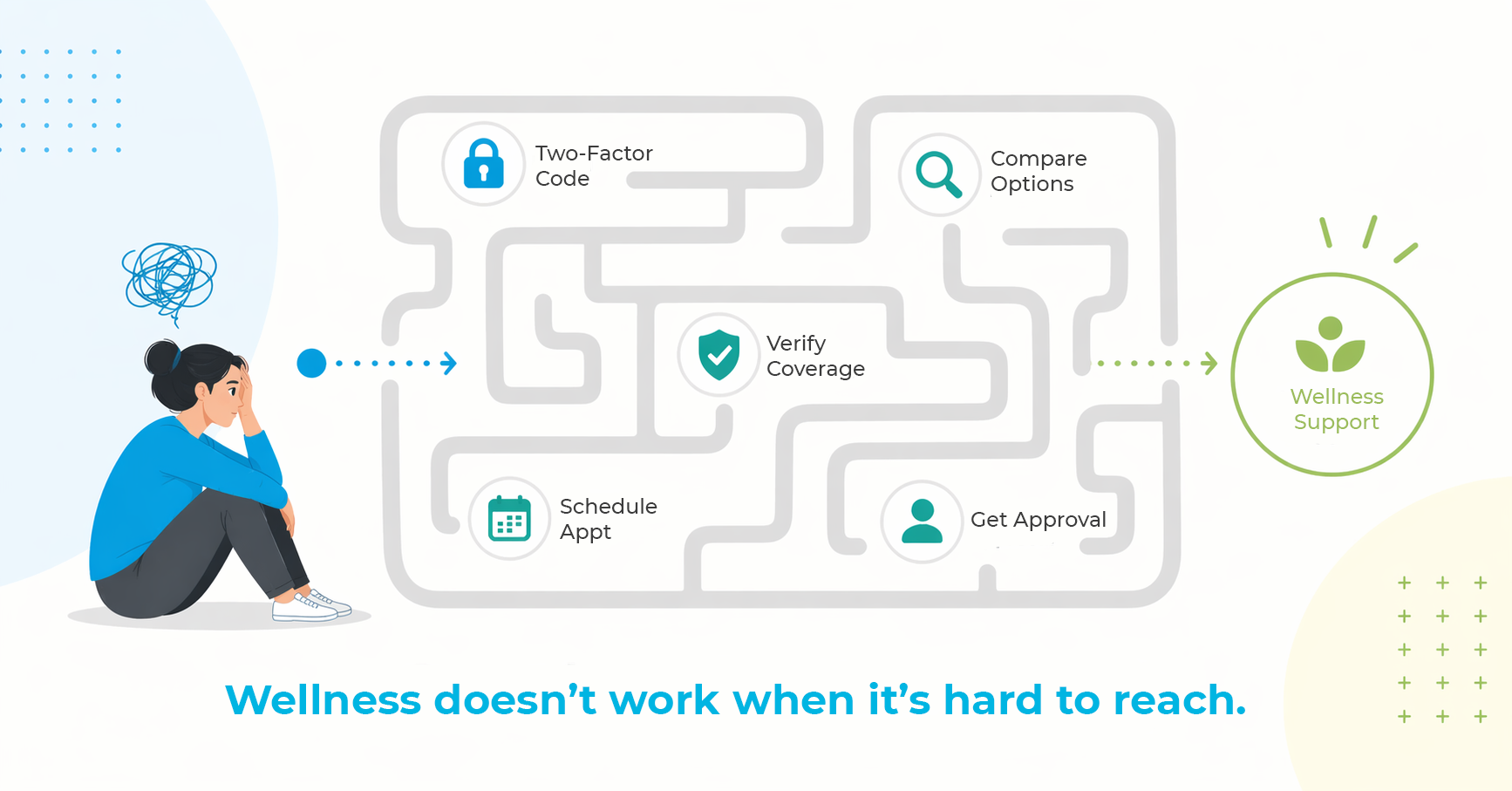
To an HR leader, it’s a comprehensive, top-tier benefits package. To a stressed-out employee who just spent six hours in back-to-back Zoom calls, it’s a 17-click maze of forgotten passwords, confusing portals, and "verify your identity" loops.
It's rarely one big obstacle. It's a series of small friction points that stack up until the whole thing feels like more work than it's worth. Think of it like a relay race where each leg has to go smoothly for anyone to cross the finish line. If even one runner drops the baton, the whole effort stalls.
Let's walk through each stage.
Step 1: They Can't Find the Benefit
Before an employee can use a wellness benefit, they have to know it exists and know how to access it. That sounds basic, but it's where a lot of programs lose people first.
Benefits are typically communicated during open enrollment, buried in a PDF, or mentioned once in a company-wide email. After that initial push, they disappear from view.
Here's what that looks like in real life: an employee has been dealing with stress headaches for weeks. They vaguely remember hearing something about an EAP (Employee Assistance Program) during onboarding. But they can't remember the name of the platform, where to log in, or who to ask. So they do nothing.
Common barriers at this stage:
- Benefits are only communicated once a year
- Too many platforms and portals with different logins
- No centralized, easy-to-find resource hub
- Employees don't connect the benefit to the problem they're experiencing
What HR can do: Send benefit reminders throughout the year, not just during enrollment. Use simple, plain-language messaging that connects each benefit to a real-life need. A monthly "Did you know?" email spotlighting one benefit at a time goes a long way.
Step 2: They Don't Understand It
Let's say an employee does find the benefit. The next hurdle is figuring out what it actually covers and how to use it.
Wellness benefits can be confusing. What's included in the mental health coverage? Does the gym reimbursement apply to a yoga studio? Do they need a referral for the nutrition counseling? If an employee has to work to answer those questions, most won't bother.
This is especially true for employees who are already overwhelmed. When someone is running on empty, cognitive load is real. They don't have extra bandwidth to decode insurance jargon or navigate a complicated benefits portal.
Common barriers at this stage:
- Benefit descriptions are written in HR or insurance language, not plain English
- FAQs are hard to find or don't address common questions
- Employees aren't sure if they're eligible or if there's a cost involved
- The sign-up process requires too many steps upfront
What HR can do: Audit your benefits communication from an employee's perspective. If it takes more than two minutes to understand what a benefit covers and how to access it, simplify it. Consider creating one-page explainers or short videos that walk employees through each program step by step.
Step 3: They Don't Quite Trust It
Here's a barrier that doesn't get talked about enough: trust.
Employees may hesitate to use certain wellness benefits, particularly mental health resources, because they're worried about privacy. Will HR find out? Could it affect their job? Is this information shared with their manager?
Those concerns are understandable. And in workplaces where there isn't a strong culture of psychological safety, the fear of stigma is very real.
Financial wellness tools and health screenings can trigger similar hesitations. Employees may worry about judgment, about what their data is used for, or about being seen as someone who is struggling.
Common barriers at this stage:
- No clear communication about what is and isn't confidential
- A workplace culture that doesn't normalize asking for help
- Past experiences (in this job or a previous one) where vulnerability didn't feel safe
- Benefits that feel tied to performance metrics or incentive structures
What HR can do: Be explicit about confidentiality. Put it in writing and say it out loud during benefits presentations. Normalize wellness by having leaders share that they use these benefits, too. Culture change is slow, but visible leadership behavior makes a real difference.
Step 4: They Can't Find the Time to Schedule It
Okay, so the employee found the benefit, understands it, and trusts it. Now they need to actually schedule something. And here is where a surprisingly large number of people fall off.
Scheduling wellness-related appointments, whether it's a therapy session, a flu shot, or even a virtual fitness class, requires a specific kind of intention. It means carving time out of a day that is already too full.
For hourly workers, this is especially hard. Taking an hour for a health screening might mean losing an hour of pay, or navigating a complex process to get supervisor approval for time off.
For salaried employees, it can feel self-indulgent to block off work time for something that "isn't urgent." Even if they logically know it's valuable, the calendar feels like enemy territory.
Common barriers at this stage:
- Limited appointment windows that don't fit work schedules
- No on-site or workday access to services
- Scheduling portals that are clunky or require multiple steps
- No manager buy-in that makes wellness time feel truly acceptable
What HR can do: Bring wellness to where employees are. On-site flu shot clinics, biometric screenings, or lunchtime wellness programming removes the scheduling barrier almost entirely. When employees don't have to go anywhere or rearrange their day, participation goes up.
Step 5: They Don't Follow Through
Even after all of that, some employees will sign up, intend to go, and then simply not follow through. Life gets in the way. The appointment gets pushed. The habit never forms.
This isn't a failure of willpower. It's a design problem. Wellness programs that rely entirely on individual motivation, with no reminders, no accountability, and no easy re-entry point, tend to lose people here.
Think about how many times someone has signed up for a gym reimbursement program in January and forgotten about it by March. Or registered for a wellness challenge and dropped off after week two. The initial enthusiasm was real. The follow-through just didn't have any structure supporting it.
Common barriers at this stage:
- No reminders or nudges after the initial sign-up
- Programs feel all-or-nothing (miss one week and it feels like starting over)
- No social element or peer accountability
- Benefits expire or have complicated reimbursement deadlines that create hassle
What HR can do: Build in simple touch points. Automated reminder emails, progress check-ins, or peer wellness challenges can help keep people engaged without requiring a lot of HR time. Make it easy to re-engage if someone misses a stretch. Low-barrier entry points (like a 10-minute guided stretch at lunch) matter more than you might think.
What This Means for Your Wellness Program
The gap between "we offer great benefits" and "employees actually use them" is almost never about the benefits themselves. It's about friction at every step of the journey.
When you map out the full experience, from discovery to follow-through, you can start to see exactly where your program is losing people. And most of the fixes aren't expensive. They're about clearer communication, smarter timing, and a culture that makes it feel safe and normal to take care of yourself at work.
Employees want to be well. They just need a path that doesn't feel like an obstacle course.
What friction points have you noticed in your wellness program? We'd love to hear what's working, and what's not. Please share in the comments.