
TL;DR: Fun is a biological necessity that reduces stress, boosts creativity, and strengthens social bonds. It’s not a distraction from wellness — it is the fuel that powers cognitive flexibility and emotional resilience.
 Remember when fun used to happen naturally?
As kids, we didn’t schedule it, optimize it, or feel guilty about it. We played games in the driveway until the streetlights came on and laughed at ridiculous things. We explored, created, and tried new experiences simply because they sounded cool.
Somewhere between adulthood, responsibilities, and endless to-do lists, many of us quietly stopped treating fun like an important part of life. Instead, it became something extra. Something you earn only after the work is done or something that belongs on a vacation day when life calms down. Fun became optional because our culture began prioritizing productivity and problem-fixing over the genuine joy and play that actually support our mental health.
For many adults, life has turned into a cycle of productivity, recovery, and repetition. Wake up. Work. Handle responsibilities. Try to rest. Repeat. Even our well-being conversations focus almost entirely on fixing problems like burnout, sleep struggles, and exhaustion. While those are vital topics, there is often something missing from the conversation: real moments of enjoyment, connection, and curiosity.
Interestingly, research continues showing that these moments of fun may matter far more for our resilience and mental wellbeing than we realize.
The Science Behind Fun
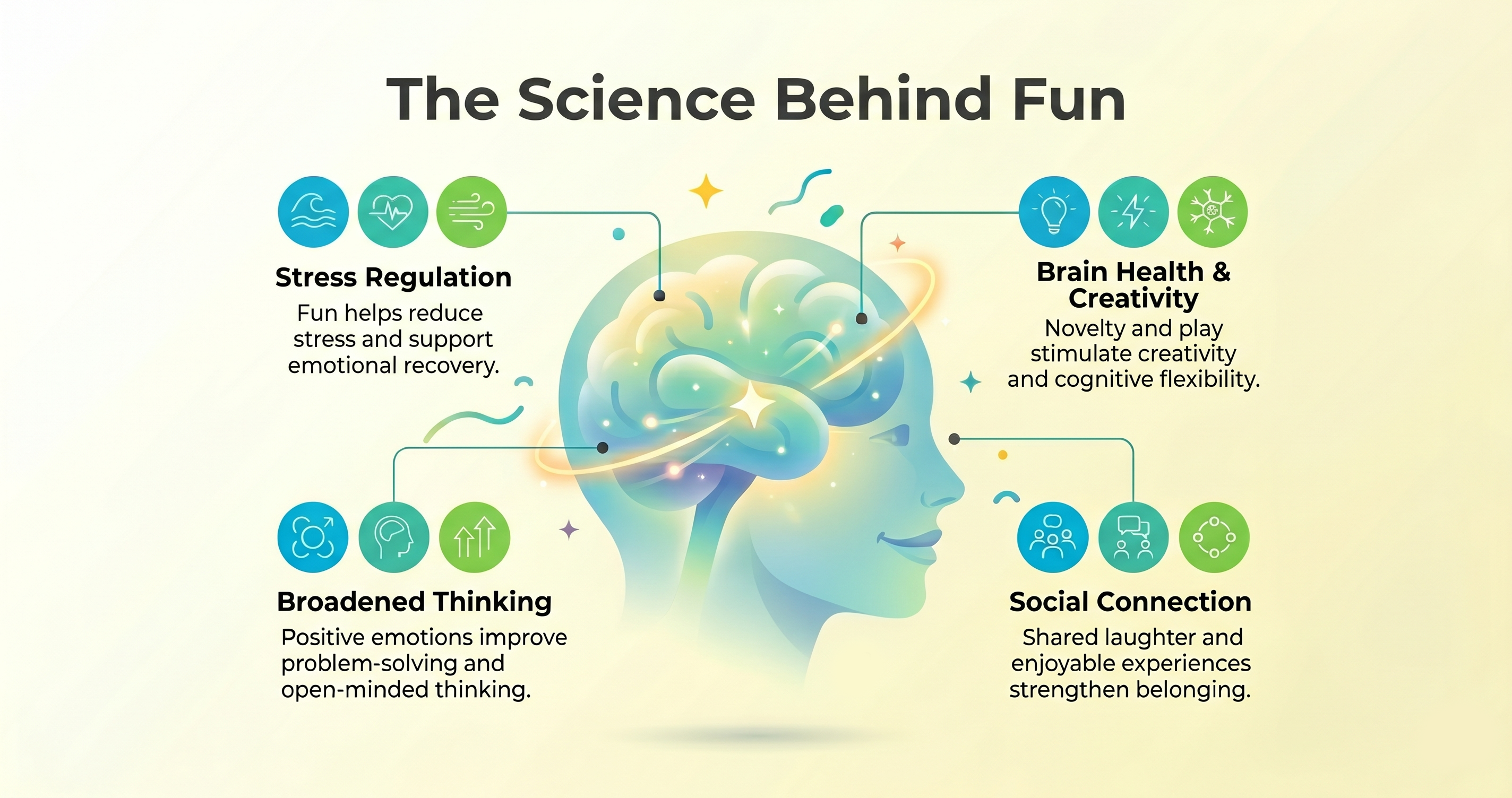
Fun isn't just "fluff." It actually changes your brain chemistry in ways that make you more effective at life. When we engage in things we enjoy, our bodies release a cocktail of feel-good hormones like dopamine and endorphins.
But the science goes deeper than just a temporary chemical rush.
Psychologist Barbara Fredrickson’s Broaden-and-Build Theory offers one of the most compelling frameworks for understanding why joy matters. The theory proposes that positive emotions — including joy, interest, curiosity, and amusement — literally broaden our cognitive and behavioral repertoire.
When we feel good, we don’t just "feel better." We actually:
- See more options: Our peripheral vision and cognitive scope expand.
- Think more flexibly: We are better at connecting unrelated ideas and solving complex problems.
- Take creative risks: Joy creates the urge to play and push limits, which is essential for innovation.
Contrast that with chronic stress or emotional flatness. Under stress, our thinking narrows. We focus on immediate survival and putting out fires rather than long-term problem-solving. Positive and negative emotional states don’t just feel different; they produce entirely different cognitive outputs.
Why Adults Struggle to Prioritize Joy
If fun is so good for us, why do we treat it like a chore?
Most of us live in a productivity culture that tells us every minute of the day needs to be "optimized." We feel guilty for resting if we haven't checked enough items off our to-do list. We start to believe that fun has to be earned, leading to a cycle where we only allow ourselves to enjoy life when we are already too exhausted to truly appreciate it.
This burnout mentality makes us view play as unproductive. We get so caught up in self-improvement— reading the right books, doing the right workouts, eating the right foods — that we forget to do things just because we like them.
There’s also guilt.
A surprising number of adults feel uncomfortable doing something that serves no practical purpose. They instinctively ask:
- Shouldn’t I be doing something more useful?
- Have I earned this yet?
- Is this a waste of time?
But constantly delaying joy creates its own consequences.
A life that contains only obligation eventually starts to feel emotionally flat. And workplaces built entirely around efficiency often end up draining the very creativity and energy they depend on.
What Fun Actually Looks Like
We often confuse fun with leisure or distraction, but they aren't the same thing. Scrolling through social media for an hour might feel like a break, but it rarely leaves us feeling revitalized.
True fun usually requires a level of active engagement or curiosity. It is the difference between watching a travel show and actually wandering through a local farmers' market. To reclaim your joy, it helps to realize that fun doesn't require a high price tag or a massive time commitment.
Real-life fun often looks like:
- Low-Stakes Curiosity: Spending twenty minutes falling down a "Wikipedia rabbit hole" about a topic that has nothing to do with your job.
- Shared Levity: That specific type of laughter that only happens when you and a teammate find the same absurd thing hilarious.
- The Flow State: Getting so lost in a creative hobby — whether it’s gardening, coloring for fun or cooking — that you temporarily lose track of time.
- Unstructured Exploration: Choosing to take the scenic route home just to see what a different neighborhood looks like.
Why This Matters at Work
For HR and wellbeing leaders, the fun factor is a serious business metric. Humans are not machines. We can’t just run on high-pressure output mode indefinitely.
When organizations invest only in stress management, they are often treating the symptoms without looking at the culture. A workplace where joy feels impossible is a workplace where burnout is inevitable.
Creativity and engagement are fueled by positive emotions. Teams that laugh together and experience moments of levity are more resilient when challenges arise. Sustainable performance requires emotional variation — we need the highs of shared success and the lightness of play to balance out the heavy lifting of our daily roles.
In his research on The Fun Habit, Mike Rucker warns that forced fun tends to backfire when organizations try to manufacture enjoyment without first creating trust and psychological safety.
Employees do not want mandatory fun. They want cultures where being human is allowed.
That can look like:
- More flexibility and breathing room
- Leaders modeling healthy behavior
- Space for informal connection
- Creative autonomy
- Recognition that recovery supports performance
- Workdays designed with actual human energy in mind
Integrating Fun Into the Everyday
Reclaiming your joy doesn’t require a vacation, a perfectly balanced schedule, or a complete life overhaul. More often, it starts with small shifts in how we think about fun.
Here are a few simple ways to bring more fun into everyday life:
- Schedule "Play" Before Exhaustion Hits: We often leave our hobbies for the very end of the day when our energy is at zero. Try scheduling 15 minutes of something you actually enjoy for a Tuesday morning or a Thursday lunch break. By doing it when you still have energy, you actually get to experience the joy of it.
- Inject Novelty Into the Mundane: Routine is the enemy of fun. You can spark micro-joy simply by changing how you perform your daily tasks. Swap your usual coffee for a new seasonal blend, take your laptop to a park for an hour, or listen to a comedy podcast instead of the news during your commute.
- Protect Your Hobbies Like a Meeting: Your interests are not extra. They are essential maintenance for your brain. Whether it’s building a LEGO set, gardening, reading the latest thriller or painting, treat that time with the same respect you give a work meeting. If someone asks for that time, tell them you have a prior commitment — because you do.
- Take a Micro-Adventure: You don't need a plane ticket to explore. Find one small thing each week that feels like an event. Visit that weird antique shop you always drive past, try the new bakery three towns over, or walk a trail you’ve never been on. These small shifts in environment signal to your brain that life is more than just a series of tasks.
- Create Unstructured Social Moments: Stop trying to program every social interaction with a formal dinner or a structured activity. Sometimes the best fun happens in the gaps — the five minutes of joking before a meeting starts or a quick, unplanned walk with a neighbor. Let go of the agenda and just let the conversation wander.
Let Fun Count
It is easy to dismiss small moments of joy as silly or unimportant when compared to the gravity of our professional and personal responsibilities. But these moments are exactly what build a life that feels worth living. They are the shock absorbers for the bumps in the road and the sparks that keep our creative fires burning.
We have to stop waiting for the perfect time to enjoy ourselves. Life is never going to be calm enough, the to-do list is never going to be truly empty, and there will always be a new problem to solve. If we wait for the absence of stress to have fun, we might be waiting forever.
Reclaiming your joy starts with a simple choice: deciding that having a good time is a valid use of your time. Start small. Choose curiosity over efficiency. Let yourself laugh at the ridiculous. Most importantly, let the fun count, even when it’s small. Your brain, your body, and your team will be better for it.